
Email vs WhatsApp: Choosing Your Channel
The comparison is usually presented as a contest, with open rates as the scoreboard. That framing is misleading in both directions: it flatters WhatsApp, where almost everything gets opened because almost nothing gets sent, and it undersells email, which is still the only channel that can carry a document, a long explanation or a permanent record.
The two channels have genuinely different mechanics. Once you understand those, the question stops being which one wins and becomes which one should carry each type of message — which is a question you can actually answer.
Five structural differences that decide everything
Cost behaves in opposite directions. Sending an extra email costs almost nothing, so email economics reward volume: send more, and a few more people respond. WhatsApp is priced by Meta per conversation, so every additional send has a real marginal cost. That sounds like a disadvantage and mostly is not — it forces frequency discipline that email programmes have to impose on themselves and usually fail to.
Permission is enforced rather than assumed. Email consent is a matter of your own policy and your local law. WhatsApp adds a platform layer on top: business-initiated messages outside the 24-hour window must use a template Meta approved in advance, and customer complaints feed directly into a quality rating that throttles you. Nobody polices your email list this way.
The failure modes are opposite. Email fails quietly. Send to a stale list and your messages slide into spam folders and promotions tabs; your reports still look plausible for months. WhatsApp fails loudly and quickly. Blocks and reports drop your quality rating within days, and the platform limits you. Loud failure is unpleasant and much more useful, because you find out.
Format capability is not close. Email holds long-form content, layout, attachments and links to anywhere. WhatsApp is short, mobile-first and interactive — buttons, quick selections, media, and a reply from the customer that starts a real conversation. Trying to send a newsletter over WhatsApp produces something nobody reads; trying to have a conversation over email produces a thread nobody replies to.
The identifiers differ in quality. An email address can be created in ten seconds and abandoned as easily, so email lists are large and partly fictional. A phone number is harder to fake and rarely discarded, so WhatsApp lists are much smaller and much truer. Comparing list sizes between the two is meaningless; comparing what fraction of each list is a real, reachable person is not.
What each is genuinely better at
Email is better for:
Long-form content — guides, updates, anything that needs more than a phone screen.
Documents. Invoices, receipts, contracts and statements belong somewhere searchable and permanent.
Anything the customer may need to find again in six months.
Broad, low-cost re-engagement of a dormant audience, where the per-message cost of WhatsApp would be hard to justify against the response you expect.
Formal communication, including anything with legal weight.
WhatsApp is better for:
Time-sensitive messages, where hours matter — delivery windows, appointment reminders, genuine deadlines.
Anything that should prompt a reply. A question over WhatsApp gets answered; a question over email mostly does not.
Service conversations, especially ones that continue over several days.
Short confirmations and status updates.
Recovery messages, where the timing and the brevity are the whole point.
Reaching people who do not really use email — which, depending on your market and your customers' age, may be most of them.
A message-by-message split
The practical output is an assignment, not a preference. For a typical business:
Message | Channel | Why |
|---|---|---|
Order confirmation | Both | WhatsApp for the immediate reassurance, email for the receipt they can find later |
Dispatch and delivery updates | Time-sensitive and short | |
Invoice or statement | Needs to be a document, and needs to be searchable | |
Appointment reminder | Needs to arrive and needs a reply if they cannot make it | |
Newsletter or long update | The format does not fit a chat thread | |
Flash offer, last-call | Only worth sending if it arrives now | |
Basket recovery | Brevity and timing decide whether it works | |
Onboarding series for a new customer | Enough substance to need the room | |
Support conversation | Two-way, continuous, and already in their app | |
Cold outreach | Neither, ideally | If you must, email — WhatsApp will cost you your rating |
That last row is worth stating plainly. WhatsApp is not an acquisition channel for people who have not heard of you. Messaging strangers on it damages the account you will need later.
Running both without annoying anyone
Most businesses end up with both, and the failure mode is duplication: the same offer arriving twice within an hour, which reads as carelessness rather than thoroughness.
Give each channel a job and stick to it. If WhatsApp owns delivery updates, email should not also send them. Overlap should be deliberate — the order confirmation above is a reasonable exception, because the two messages do different things.
Suppress across channels. Someone who bought from the WhatsApp campaign should be excluded from the email version. This needs your lists to share an identifier, which is worth setting up once.
Respect the opt-outs separately, and honour both. Consent for email is not consent for WhatsApp, and someone who leaves one list has not necessarily left the other. Treat a WhatsApp opt-out as final, because the alternative is a block, which is worse for you.
Match the frequency to the channel. A weekly email is unremarkable. A weekly promotional WhatsApp message is a lot, and a daily one will empty your list.
Where they connect in Scope Wiser
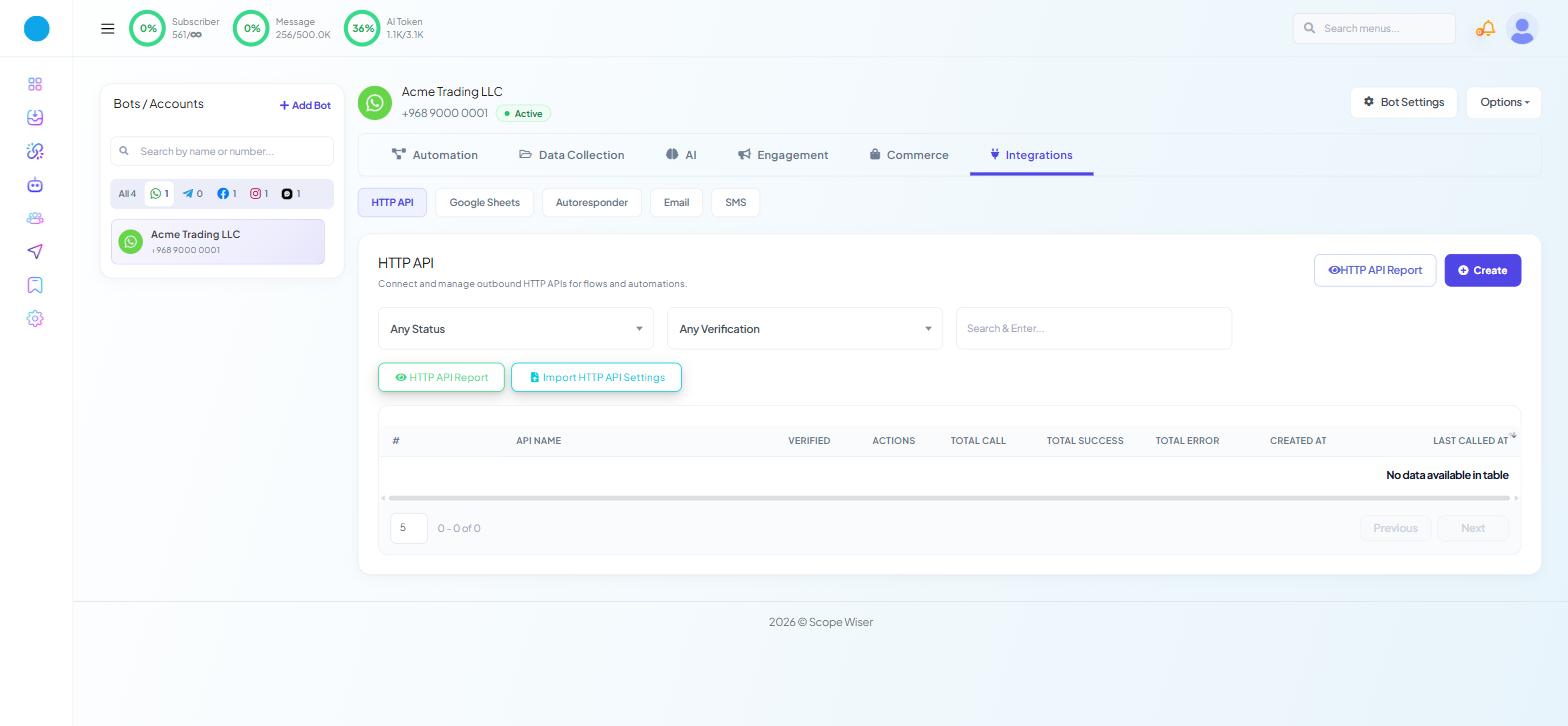
Email and SMS sit alongside your messaging channels as per-bot integrations, under Chatbot Manager › Integrations, where Email and SMS appear next to HTTP API and Google Sheets. Bot-level email settings are in the Bot Settings panel, on the Email tab, alongside Business Hour and Auto Responder.
Be clear about what that email is, because it is narrower than the comparison above might suggest. Scope Wiser sends through your own SMTP account, or a dedicated service such as Mailgun or Postmark — it is a notification channel, not an email marketing platform. One message, to one subscriber, at the moment they hand over an address: a welcome note, a confirmation, a coupon, a download link. There is no campaign builder, no scheduling, no list management and no bulk send. Email Setup and SMTP Configuration and Email Providers: Mailgun, Postmark and Domain Verification cover the setup.
So the email half of the split above lives in an email tool, not here. For newsletters and sequences, connect one: Autoresponders: Mailchimp, Brevo, ActiveCampaign and Mautic pushes addresses collected in a conversation straight into a list. That is the practical shape of running both — a flow collects the address on WhatsApp, your email programme carries the long, documentary half, and the short, urgent half stays in the thread, from one contact record.
On the statistics you will encounter
This comparison attracts unusually confident numbers — open rates, click rates, revenue multiples, all quoted without a source you can check. Some of them are broadly directionally true. Most are not comparable, because "open" means something different on each channel, and because the businesses that report these figures are not running controlled tests.
Do not plan around them. Run the same offer to a matched segment on each channel, measure orders rather than opens, and you will have one figure that is worth more than every benchmark you can find — because it is about your customers.
What to do next
If the split above suggests WhatsApp should be carrying more than it currently does, start with WhatsApp Marketing: The Complete Guide, which covers opt-in, templates and the order to build things in. If you run an online shop, eCommerce Playbook: WhatsApp for Online Stores maps the same decisions onto a store's specific messages.