
Improving Customer Experience & Engagement
Bad messaging experiences are remarkably consistent. People complain about the same four things regardless of the business: they waited too long, they had to repeat themselves, the reply did not answer the question, and they could not reach a person when the automation ran out of road.
Everything worth doing about customer experience in a messaging channel comes down to removing one of those four. This post takes them in turn.
Speed, and what "fast" actually needs to mean
Messaging carries an expectation borrowed from personal conversation. Someone who messages a business at nine in the evening does not consciously expect a person to be there, but they do expect the thread to do something. Silence reads as being ignored in a way that an unanswered email does not.
The fix is not a faster team. It is making sure nothing is ever met with nothing.
Acknowledge immediately, always. Even where the real answer needs a person, the first reply should arrive in seconds and say what happens next.
Set your business hours properly so the out-of-hours message is accurate rather than aspirational. In Scope Wiser these live under the Bot Settings panel, on the Business Hour tab, with Auto Responder alongside it. Remember to use Publish Changes — settings you have edited but not published are not live.
Give a real time, not a vague one. "Someone will reply by 10am tomorrow" beats "we will get back to you shortly" because it can be relied on, and because it can be kept.
Do not promise instant answers you cannot deliver. An honest twelve-hour promise that holds produces better experiences than a one-hour promise that slips.
Continuity, or not making people repeat themselves
The second complaint is the one businesses under-rate most. Being asked for your order number for the third time is not a small irritation; it is the moment a customer concludes you are not paying attention.
Messaging solves this better than any channel before it, because the thread is permanent. The customer can scroll back. So can you — provided your setup keeps everything in one place.
Practically, that means:
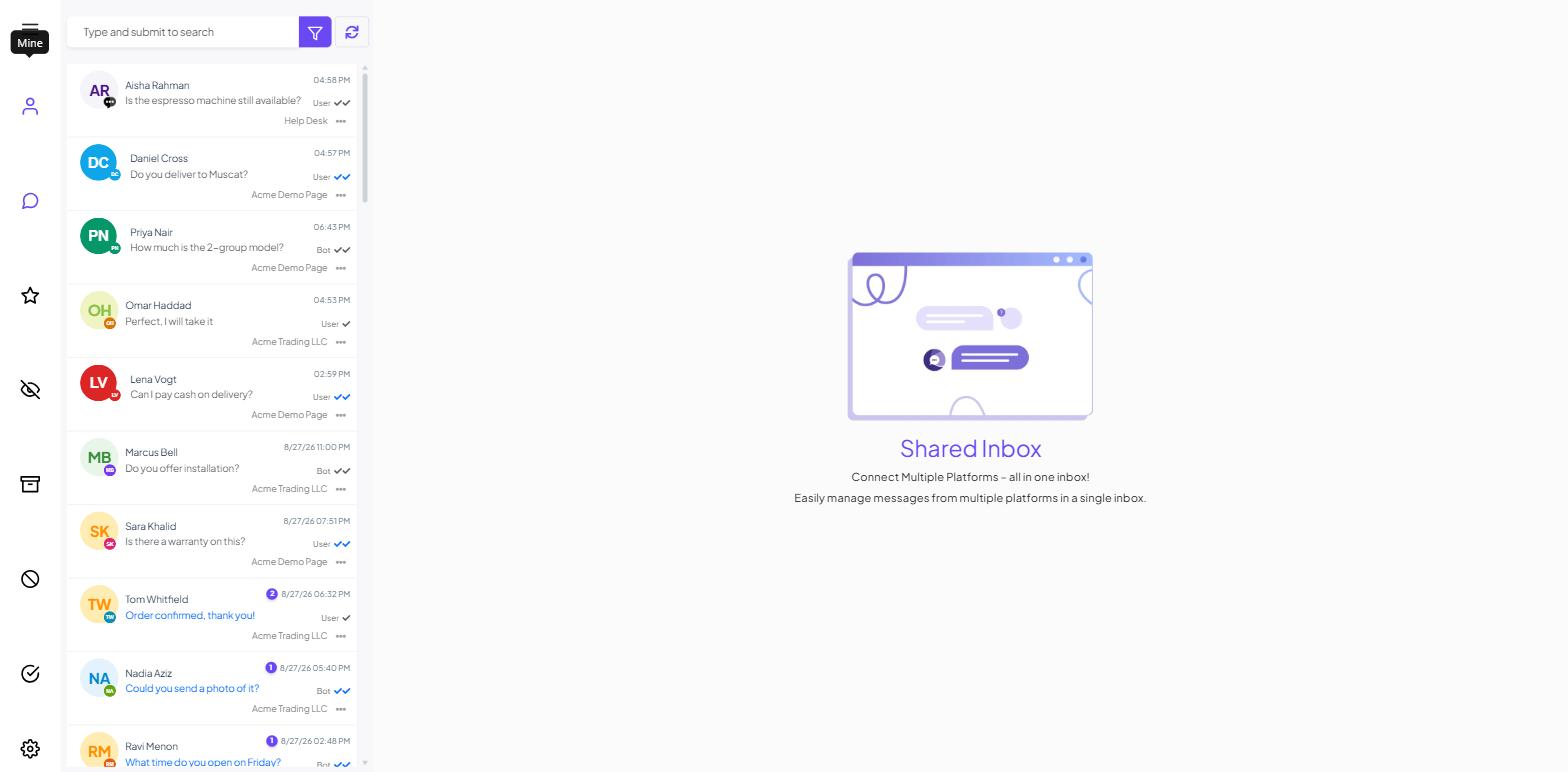
One inbox for every channel. The Shared Inbox brings WhatsApp, Facebook, Instagram and Webchat conversations together, so a person who messaged on one and followed up on another is still recognisably the same person.
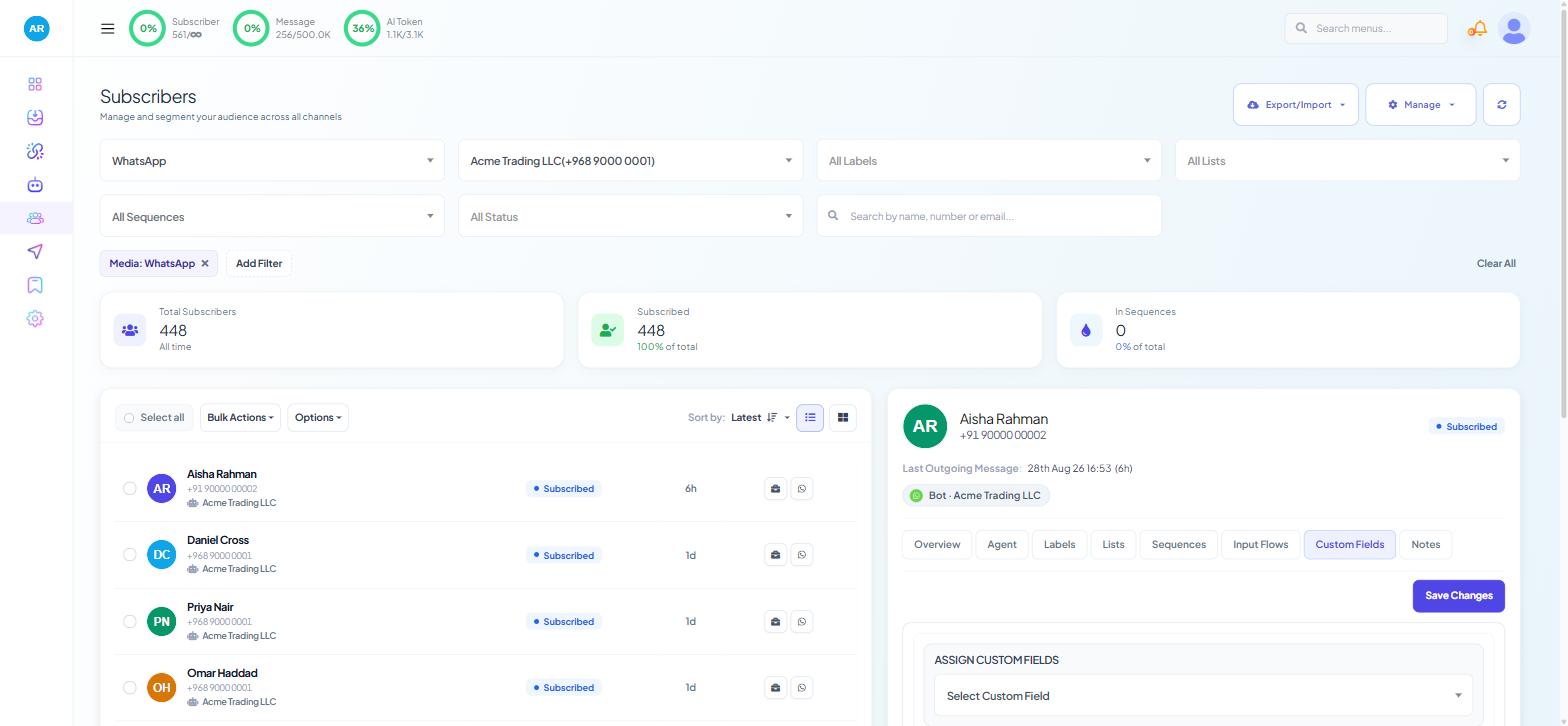
Data captured once and stored. Answers collected in a User Input Flow should be written to custom fields on the subscriber record, not just used and discarded. What you store is what you never have to ask again.
Labels that reflect real states. A label like
awaiting-refundon a subscriber record tells the next agent what is going on without them reading the whole history.Notes for context that does not belong in the transcript. The Subscriber Manager detail panel has a Notes tab for exactly this.
Relevance, which is what personalisation actually means
Personalisation has been reduced to inserting a first name, which does nothing. Nobody has ever felt understood because a promotional message spelled their name correctly.
What people notice is relevance — being sent things that make sense given what they have already done. That requires stored data and segmentation rather than merge fields.
Three levels, in increasing order of effort and effect:
Do not send people things that do not apply to them. Exclude recent purchasers from the acquisition offer. Exclude the people who already complained about the delay from the cheerful follow-up. The exclude fields in a broadcast configuration do more for perceived quality than any amount of copywriting.
Vary the message by what someone bought or asked about. Category labels make this straightforward.
Branch the conversation on stored answers. A Condition block in the Flow Builder reading a custom field is how a flow stops asking questions it already knows the answer to.
Honest automation
Customers are far more tolerant of bots than the received wisdom suggests — provided nobody tries to disguise one as a person. The resentment starts when someone realises they have spent four minutes explaining a problem to something that was never going to understand it.
So be plain about it. An automated greeting that says it is automated and offers a route to a person costs you nothing and sets an expectation that can be met. Pretending otherwise guarantees a bad moment later.
The same honesty applies to capability. A bot that handles four things well and says so is a good experience. A bot that implies it can handle anything and then loops is the worst kind, because the customer has no way to escape and no idea what went wrong.
Where you use an AI agent — configured under Chatbot Manager › AI, with AI Configuration and Agents — the same rule holds. Ground it in your own material and let it hand over when it is out of scope, rather than letting it improvise an answer about your refund policy.
Handover that actually works
The moment automation gives up is the highest-risk point in the whole experience, and it is usually the least designed.
A good handover has four properties:
The customer can trigger it. A visible option to reach a person, available at every step, not buried after three failed attempts.
The agent inherits the context. They should be reading the conversation, not starting a new one.
The customer is told what is happening. "I'm passing this to a colleague — they'll reply within the hour" closes the loop.
It is honest about time. Out of hours, say so, and say when.
In the Shared Inbox, the icon rail on the left filters conversations — Mine, All, Important, Unread, Archived, Blocked and Resolved. Agreeing as a team what each of those states means, and using them consistently, is what stops handed-over conversations from quietly falling through.
Tone in a personal channel
WhatsApp sits alongside a customer's family threads, so the register that works in a marketing email reads as shouting there.
Short messages. Several short ones beat one long one; the thread is not a page.
Plain words. Nobody wants to parse marketing vocabulary while trying to find a parcel.
No exclamation-heavy enthusiasm in service contexts. Someone chasing a late delivery does not want cheerfulness.
Say the thing first. Lead with the answer, then the detail.
Match the customer's formality, do not impose your own.
Measuring it without deceiving yourself
Satisfaction surveys sent immediately after a resolved conversation are heavily biased towards the people you just helped. They are worth running, but not on their own.
More honest signals:
Time to first meaningful reply — not to the auto-acknowledgement, which is always instant.
Repeat contacts about the same issue. A conversation marked resolved that reopens two days later was not resolved.
Escalation rate, and more importantly why. A rising rate might mean your automation is failing, or it might mean it is correctly recognising that it should not try.
Block and opt-out rates by campaign. This is the metric that tells you the truth about frequency, and it is the one businesses look at last.
What to do next
To pick which conversations to automate first, work through Chatbot Use Cases by Industry — its inbox-audit method is the fastest way to find where experience is currently failing. For pacing automated replies so they read as conversation rather than machinery, see Delaying Bot Replies with Delivery Options.