
Why Conversational Marketing Works
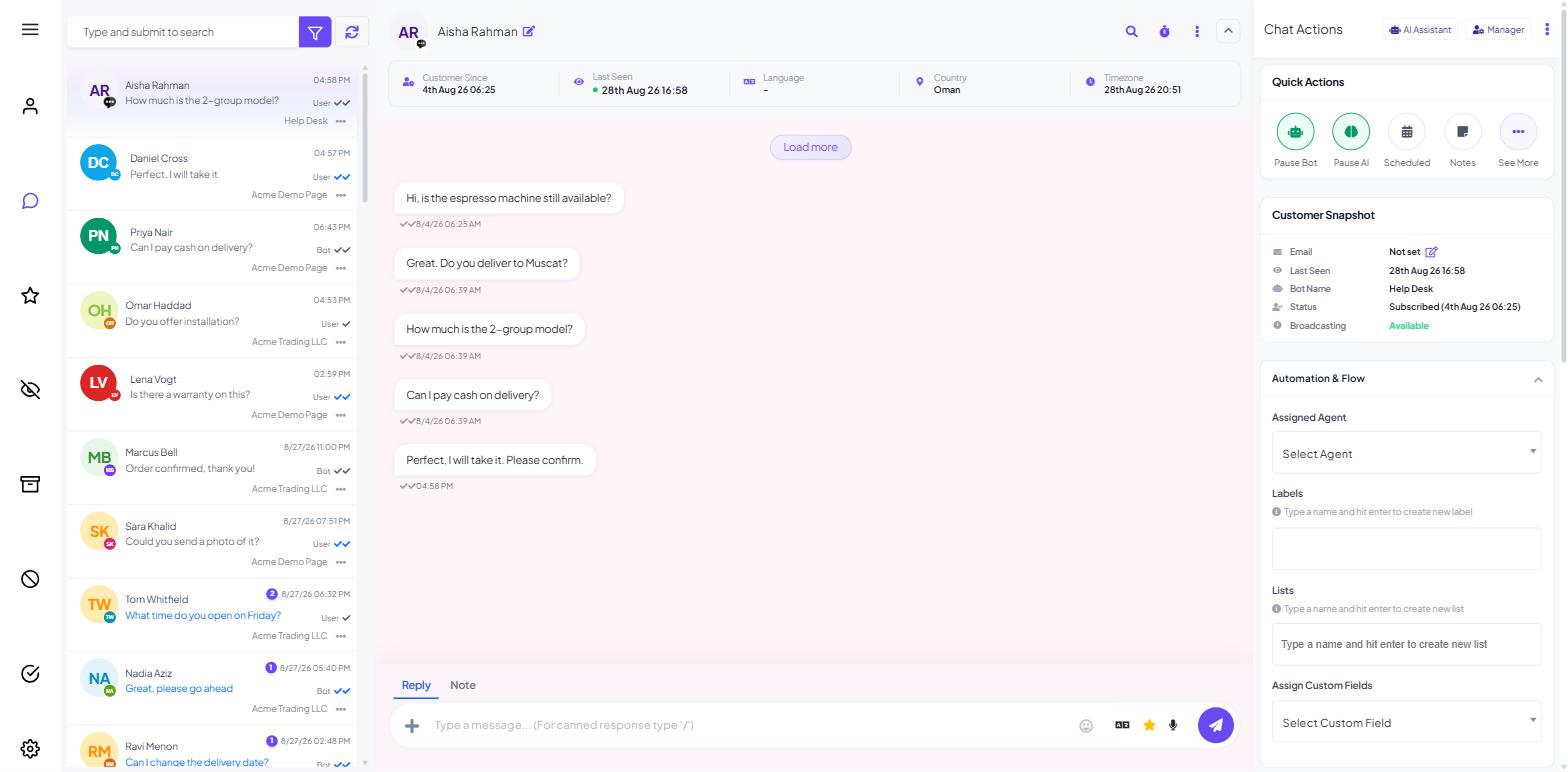
Conversational marketing gets explained badly. The usual version is a list of benefits — always on, instant replies, lower costs — which is true and tells you nothing about why it works or when it does not. The interesting question is mechanical: what is different about a message thread that makes it outperform the form, the newsletter and the call queue it replaces?
Three things, mostly. Understanding them tells you where to point a chatbot and, more usefully, where not to.
It removes the wait, and the wait is where you lose people
Someone with a question about your product has a narrow window of intent. They are looking at your page, they want to know whether the thing fits, and their attention is already partly elsewhere. A contact form answers them tomorrow. A phone queue answers them after a hold long enough that, for most people, it means never.
An automated reply answers them now. Not brilliantly — the first reply is rarely the clever part — but before the intent decays. That is the whole trick. A mediocre answer that arrives immediately beats an excellent one the following afternoon, because the second one arrives after the person has bought elsewhere or forgotten why they asked.
This is why the highest-value automation is almost never the sophisticated kind. It is the flow that handles "do you deliver to my area", "is this in stock", "what are your opening hours" and "where is my order" without anybody being woken up.
It collects information as a conversation instead of a form
Ask someone to fill in six fields and a predictable proportion abandon at field three. Put the same six things one at a time into a thread, with each answer acknowledged, and completion rates change — because each individual step is trivially small and the person can see they are nearly done.
There is a second effect that matters more. In a conversation you can branch. A form asks everyone the same questions; a flow asks the third question based on the second answer, which means you collect fewer fields and learn more from them. Someone who says they are shopping for a business does not need the consumer questions.
In Scope Wiser this is what User Input Flows under Chatbot Manager › Data Collection are for, and what the Condition block in the Flow Builder does with the answers.
It happens on infrastructure the customer already trusts
A web chat widget lives on your site. Close the tab and the thread is gone — the visitor becomes anonymous again and you have no way to reach them.
A WhatsApp conversation lives in the customer's own app, in the same list as their family and their bank. It persists. They can scroll back to the tracking link you sent three weeks ago. You can follow up without asking for an email address, because the contact already exists.
That persistence is the underrated part. Most of the value in conversational marketing is not in the first exchange; it is in being able to have the second one.
Where it genuinely earns its keep
Some patterns come up repeatedly, across very different businesses:
High-volume, low-variance questions. If four questions make up most of your inbound messages, automating them frees your team for the rest. Read your last hundred conversations and count before you build anything.
The moment after an action. An order placed, a form submitted, a booking made — the customer is expecting to hear from you. Confirmations and updates sent then are welcome messages rather than interruptions, which is rarer than it sounds.
Qualification before a human gets involved. A conversation that establishes budget, location and timing before a salesperson picks it up saves the expensive person from the unqualified half of the pipeline.
Recovery. Abandoned baskets, expired quotes, lapsed subscriptions. These need one well-timed, specific nudge — and a nudge is a natural message and an unnatural email.
Out-of-hours coverage. For a small team this is often the largest single gain, and it costs nothing beyond the setup.
Where a chatbot is the wrong answer
The honest version of this argument includes the limits, because deploying a bot into the wrong job damages the relationship it was meant to improve.
Complaints and anything emotional. Someone who is angry does not want a menu. Route these to a person immediately and make the handover fast.
Genuinely complex or high-value decisions. If the sale involves negotiation or bespoke specification, use the bot to get the conversation started and hand it over early.
Regulated advice. Financial, medical and legal guidance need human accountability. A bot can collect details and explain a process; it should not advise.
Audiences that are not on the channel. If your customers do not use WhatsApp, no amount of automation quality will fix that. Check before you build.
Anything you cannot support. A bot that answers three questions well and then dead-ends is worse than no bot, because it teaches people you will not help them.
A good rule: automate where the answer is the same for everyone, and route to a person where it is not.
The economics, stated honestly
You will find enormous ROI figures attached to this topic. Treat them sceptically — they are usually vendor-supplied, rarely comparable, and almost never adjusted for the fact that the businesses that deploy conversational tools well are already good at operations.
The durable argument is simpler. Support cost per conversation is roughly fixed when a person handles every message and falls sharply once a predictable share is handled automatically. The saving is real, it is proportional to how repetitive your inbound volume is, and you can estimate it yourself from your own inbox in an afternoon. That estimate will be worth more to you than any published benchmark.
The revenue side is harder to attribute and easier to overstate. Faster replies help conversion because fewer people leave while waiting; recovery messages retrieve orders that would otherwise be lost. Both are measurable in your own numbers if you set up the measurement before you launch, which almost nobody does.
How to start without over-building
The failure mode for a first project is ambition. A large flow that covers every branch takes weeks, launches late, and is hard to change once you learn what people actually ask.
Do the opposite. Pick the single most repeated question in your inbox and automate that one. Watch it for a fortnight. Read where people fell out of the flow or typed something it did not expect, fix that, then add the second question. Four small iterations produce something better than one large plan, because the customers write the specification for you.
Keep the escape hatch visible throughout. Every flow should have an obvious way to reach a person, and that route should stay open even when the automation is working well.
What to do next
To see how these patterns look in a specific sector, read Chatbot Use Cases by Industry, which works through what to automate first in eleven different businesses. If you are ready to build the first flow rather than plan it, Introduction to Flow Builder: How Scope Wiser Flows Are Built covers the canvas and the blocks.