
Answer Engine Optimisation: Being Found When AI Answers the Question
A search engine hands you a list and lets you choose. An answer engine — ChatGPT, Gemini, Perplexity, Copilot, the AI summary above Google's results — hands you a conclusion and, if you are lucky, a couple of citations. There is no page two. Either your business is inside the answer or it does not exist for that question.
Answer Engine Optimisation is the work of getting inside that answer. It overlaps with search optimisation but rewards different things, and the businesses that treat it as "SEO with extra steps" tend to lose ground quietly, because the metric that moves is one they were never watching.
How an answer engine picks what to say
Answer engines are not crawlers ranking pages by authority signals. They are language models assembling a response from what they have absorbed, plus whatever they retrieve at query time. The selection is closer to fact-checking than to ranking.
Three things decide whether your material makes the cut:
Can it be understood without context? A paragraph that only makes sense after reading the three above it is hard to lift. A paragraph that opens with a complete, standalone statement is easy to lift.
Is it corroborated? Models are more willing to state something that appears consistently in several independent places. A claim that exists only on your own site reads as a marketing assertion, and marketing assertions get paraphrased away rather than quoted.
Is it safe to repeat? Vague, hedged or contradictory material carries risk for the model. It gets dropped in favour of something cleaner, even from a smaller source.
None of that is gamed by keyword density. It is won by being unambiguous and consistent.
What actually changes in your content
Answer first, then explain
Put the answer in the first two sentences under the heading, in plain declarative form, before any setup. "Our returns window is 30 days from delivery for unworn items" is liftable. "We know returns can be stressful, which is why we've designed a policy around you" is not.
This is uncomfortable for writers trained to build to a point. Do it anyway, then build to the point underneath.
Head your sections with the questions people ask
Not "Our Returns Philosophy" but "How long do I have to return an item?". Question-shaped headings match the shape of what users type into an answer engine, and they force the answer-first discipline on you automatically.
The five that cover most commercial intent: What is it? How does it work? Who is it for? What does it cost? What happens if it goes wrong?
Mark up what you can
FAQ, HowTo, Product and Organization structured data give a machine an unambiguous reading of material it would otherwise have to infer. Schema is not a ranking trick here — it is a way of removing ambiguity, which is the thing answer engines penalise most.
Say the same thing everywhere
Your product name, your category, your pricing model and your service area should be phrased identically on your website, your business listings, your directory profiles and your social descriptions. Inconsistency across sources is exactly the signal that makes a model hedge.
Earn third-party mentions
An independent review, a directory listing or a mention in someone else's article corroborates what your own site claims. One credible external reference does more for AI visibility than another page of your own copy.
What this does to your metrics
The obvious effect is that visibility stops being measured in clicks. If an answer engine summarises your returns policy accurately and the customer never visits, that is a good outcome badly measured — the sale still happens, the support ticket still does not get raised.
Practical substitutes, checked on a schedule rather than daily:
Ask the major answer engines the ten questions your customers actually ask, and record whether your business is named, described accurately, or absent.
Watch for wrong answers about you specifically. A confidently stated error is worth fixing before a missing mention is worth chasing.
Track branded conversations arriving on WhatsApp and webchat. When AI search sends people to you, they often arrive already knowing what they want and ready to message rather than browse.
The part most people miss: your chatbot is a second answer engine
Everything above describes making your content legible to somebody else's model. The same material is what your own AI agent answers from, so that work is not wasted.
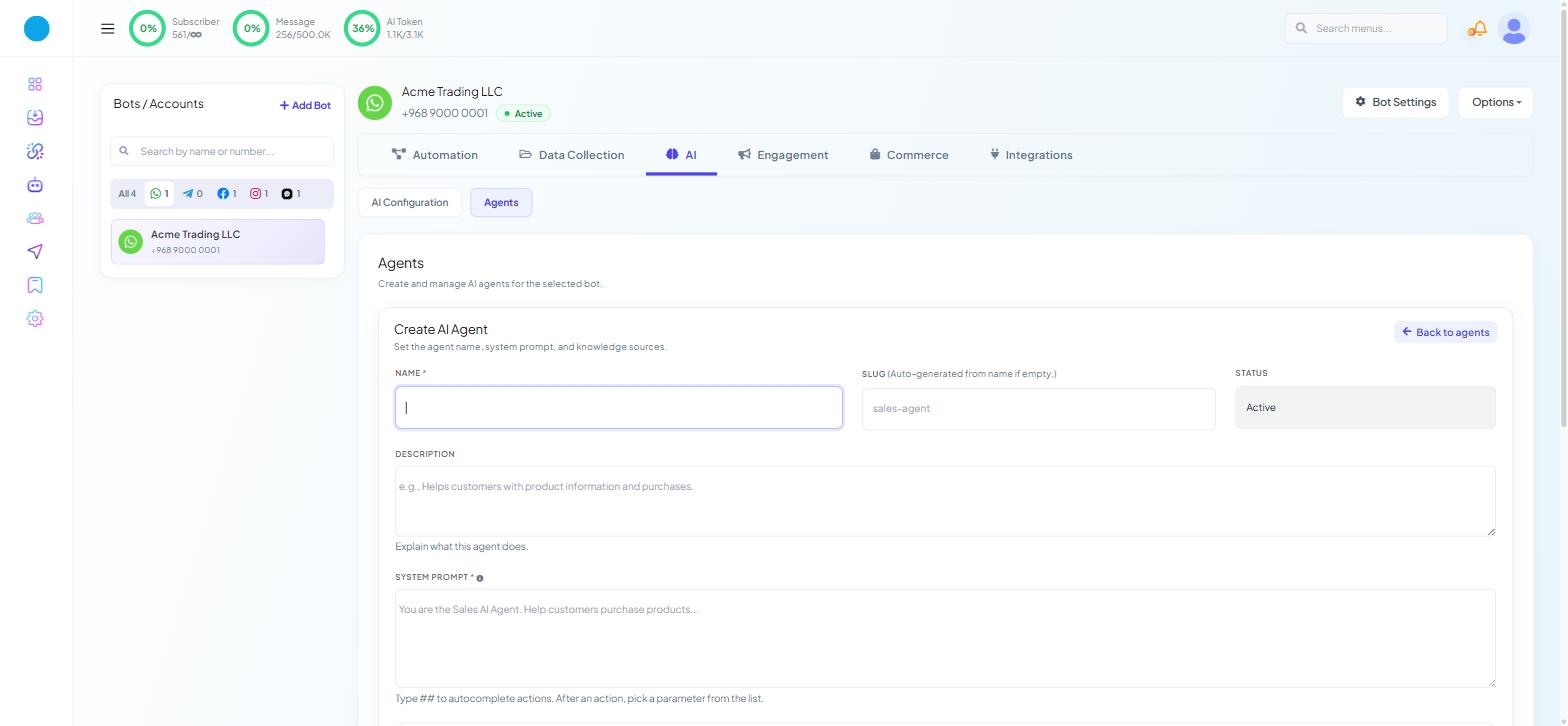
In Chatbot Manager › AI › Agents, an agent is created with a name, a SYSTEM PROMPT and a Knowledge Set. Under Knowledge Sources you attach material by type — Content, URL, File, Media, Google Sheet or API — and everything you attach becomes part of what the agent can draw on.
The URL source is the direct link. If you have rewritten your policy pages to be answer-first and internally consistent, you can point a knowledge source at those same pages, and the agent inherits the clarity. Contradictory source pages produce a contradictory agent — the failure mode is identical to the one that keeps you out of AI answers.
Two settings under Chatbot Manager › AI › AI Configuration are worth setting deliberately while you are there — turn on the AI Agent toggle first, or the page is empty. Restricted Topics takes a list of subjects the agent must not engage with, and Response for Restricted Keywords holds the message it sends instead. Both are under Behavior & Restrictions.
Mistakes that cost the most
Writing for the model instead of the reader. Content stuffed with question headings and no substance underneath reads as thin to humans and to models alike. Answer engines are explicitly tuned against promotional filler.
Leaving old contradictions in place. A price on your pricing page, a different price in a blog post from two years ago, and a third in a directory listing. Pick one, fix the others, delete what you cannot fix.
Expecting it to be fast. Retrieval and attribution shift over weeks. Becoming a source a model reaches for reliably takes considerably longer, and it takes consistent publishing rather than one push.
Treating it as a replacement for search optimisation. Answer engines still need to find and index your material in the first place. AEO adds a layer; it does not remove one.
What to do next
If you have not yet built an AI agent on top of the content you are cleaning up, start with Automating the Service Desk: What to Hand Over and What to Keep — it covers how to decide which questions the agent should own and where the handover to a person belongs. If you want the wider view of where conversational AI is heading and which parts of it are worth building for now, read Chatbot Trends Worth Building For.